Hazel eyes
A shifting blend of brown, gold and green, in about 1 in 20 people worldwide.
By the Eye Color Rarity Editorial Team · Sources checked November 2026
How rare are hazel eyes?
Hazel eyes are uncommon, at about 5% of people worldwide. That is the figure given by WorldAtlas and All About Vision, neither of which points to a primary study. We publish a range of 4–8% around it, because hazel is the color people classify least consistently.
The U.S. data shows how large that problem is. Hazel has the widest gap of any color between the two big American datasets.
| U.S. dataset | Who was counted | Hazel |
|---|---|---|
| License records, 2016 data | 235 million licenses, 31 states | 10.3% |
| Harris Poll, 2014 | More than 2,000 adults | 18% |
Why do the hazel numbers disagree?
Neither dataset had anyone look at an eye, so the gap comes down to how people describe themselves. A person with brownish-green eyes may choose "hazel" in a poll and "brown" or "green" at the DMV. Both counts rest on self-report.
The license study shows another sign of this. In Missouri, Texas, West Virginia, Wisconsin, Georgia, Kentucky and Nebraska, green outnumbered hazel, the reverse of the national pattern. The authors say self-report bias could explain people choosing green over hazel. Hazel itself runs from 7.5% in California to 18.5% in Maine, as our state-by-state table shows.
Researchers feel the same strain. The 2019 review of European eye color data folded hazel into brown so that older studies could be compared. That means we have no clean hazel figure for any European country.
What causes hazel eyes?
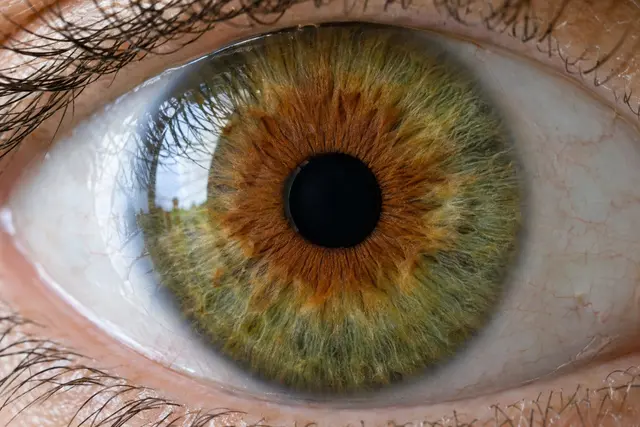
Hazel comes from a moderate amount of melanin spread unevenly across the iris. Pigment is usually densest near the pupil, which gives the brown or gold ring. Toward the edge, thinner pigment lets scattered light mix in, and the iris reads as green or lighter.
Pigment type matters as well. Research on iris tissue found a eumelanin to pheomelanin ratio of about 1.3 to 1 in hazel and blue-green irises, far lower than the 14.8 to 1 in dark brown. More of the warm, red-yellow pigment is one reason hazel has gold in it. An earlier study found that green-brown mixed irises could not be neatly labeled as one pigment type at all.
How can you tell if your eyes are hazel?
Look for two or more colors in the same iris. Hazel eyes have a visible shift from the center outward. Green eyes look mostly green across the iris, and amber eyes are one even golden tone.
The best way to check is to use a mirror in daylight, near a window but out of direct sun. Indoor bulbs add warmth and can make eyes look more golden than they are. Taking a photo helps too, as long as you turn off filters.
| Eye color | Near the pupil | Toward the edge |
|---|---|---|
| Hazel | Brown or gold ring | Green, gray-green or lighter |
| Green | May have small gold flecks | Green |
| Amber | Golden | Golden |
| Light brown | Brown | Brown |
For a closer comparison, read our guide to hazel vs. amber eyes.
Why do hazel eyes seem to change color?
The pigment doesn't change from day to day. The light does. Hazel irises mix pigment and scattered light, so the balance you see moves with brightness and with the colors around you. A green top can draw out the green, and warm indoor light can draw out the gold.
Pupil size plays a part too. When the pupil widens, it hides more of the inner ring, so less of the brown or gold shows.
Hazel eyes FAQs
What percentage of people have hazel eyes?
About 5% worldwide, in a range of 4–8%. In the United States, 10.3% of license records list hazel, while a 2014 Harris Poll found 18%.
Is hazel rarer than green?
No. Worldwide estimates put hazel at about 5% and green at about 2%. In the U.S. the two are closer, and green outnumbers hazel on license records in seven states.
What is the difference between hazel and amber eyes?
Amber is one even golden-copper tone across the whole iris. Hazel mixes colors, usually a brown or gold ring near the pupil with green or lighter tones at the edge.
Do hazel eyes really change color?
Not in the short term. The pigment stays the same, but lighting, nearby colors and pupil size change what you see. A real change in iris color is different, and a sudden one should be checked by an eye doctor.
Sources for this page
- Hashem, Menicacci & Granet: Iris color distribution in the United States of AmericaPLOS ONE (2025)
- Your Blue Eyes Aren't Really Blue (includes the 2014 Harris Poll results)American Academy of Ophthalmology
- The World's Population By Eye ColorWorldAtlas
- What is the rarest eye color?All About Vision
- Katsara & Nothnagel: True colors, a literature review on the spatial distribution of eye and hair pigmentationForensic Science International: Genetics (2019)
- Human iridal stroma melanosomes of varying pheomelanin contentsArizona State University research record
- Prota et al.: Characterization of melanins in human irides and cultured uveal melanocytes from eyes of different colorsExperimental Eye Research (1998)
Estimate ranges are our own synthesis of these sources. Read how we calculate them.