Brown eyes
The most common eye color on Earth, found in roughly three out of every four people.
By the Eye Color Rarity Editorial Team · Sources checked November 2026
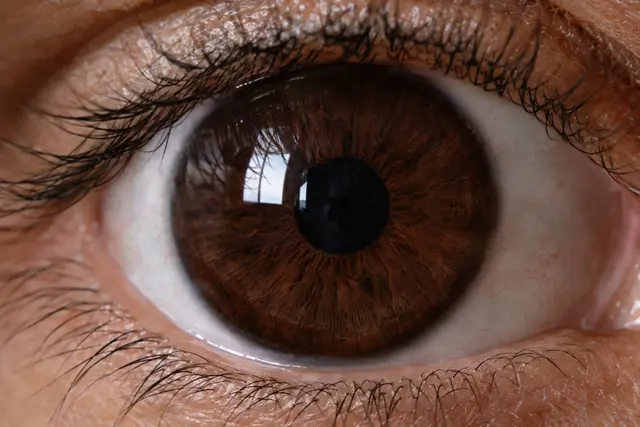
How common are brown eyes?
Brown is the most common eye color in the world, at an estimated 70–80% of people. That range comes from secondary summaries such as WorldAtlas and All About Vision. Nobody has counted eye color worldwide, so we treat it as an estimate. Even so, we give brown our only high-confidence label, because no serious source disputes the order of magnitude.
The United States is where we have real counts, and two datasets disagree. A 2025 PLOS ONE study of 235 million driver's licenses found brown or black eyes on 53% of them. A 2014 Harris Poll of more than 2,000 Americans, run for the American Academy of Ophthalmology, found 45%.
We lean toward the license figure because the sample is far larger. It still has gaps. Only 31 states supplied data, the records date from 2016, and people pick their own eye color at the DMV counter. The share also swings widely by state, from 34.3% in Wyoming to 67.1% in Texas.
What makes eyes brown?
Brown eyes are brown because the front layer of the iris holds high levels of melanin. Melanin absorbs most of the light that reaches it, so very little bounces back out. The same pigment colors skin and hair.
Melanin comes in two forms. Eumelanin is brown-black and pheomelanin is red-yellow. Research on iris tissue found that the ratio shifts with color: about 14.8 to 1 in dark brown irises, against about 1.3 to 1 in blue-green and hazel ones. So a dark brown iris has both more pigment and a darker mix of it.
The genes that set this level are covered in our genetics guide. The short version is that OCA2 and HERC2 on chromosome 15 do most of the work, and dozens of other regions adjust the result.
Where are brown eyes most and least common?
Brown dominates almost everywhere outside northern Europe. The best country-level figures come from a 2019 literature review by Katsara and Nothnagel, in the table reproduced by Healthline.
| Country | Brown eyes (hazel included) |
|---|---|
| Uzbekistan | 90.5% |
| Kazakhstan | 85% |
| Armenia | 80.2% |
| France | 34% |
| Great Britain | 31.8% |
| Germany | 27.2% |
| Netherlands | 21.7% |
| Iceland | 9.2% |
Two warnings come with this table. The review counted hazel as brown, so true brown is lower in each row. Its data is also mostly European, because few comparable surveys exist for Africa and Asia. Brown is close to universal in those regions, but we can't give you a measured percentage for them.
Are black eyes real?
No. Eyes that look black are very dark brown. The iris absorbs so much light that it blends into the pupil, especially indoors. Under a bright light the brown shows.
This is why U.S. license forms use a combined "brown/black" category. It reflects how people describe their eyes, not a separate color.
Are babies born with brown eyes?
Most are, at least in the one hospital study we have. The old claim that all babies start with blue eyes doesn't hold up. In the Newborn Eye Screening Test study, 63% of 192 newborns had brown eyes and 20.8% had blue. That is a single hospital in California, so it won't match every population.
Eyes can also keep changing later than most people assume. Our guide to blue-eyed parents and brown-eyed children covers how a baby's color settles.
Does having brown eyes affect eye health?
A little, in both directions, and only as a statistical link. A 2014 review of epidemiologic studies reported that darker irises were linked to more age-related cataract and to a lower risk of uveal melanoma. It found no consistent link with age-related macular degeneration.
None of this tells you anything about your own eyes. Regular eye exams matter far more than your iris color.
Brown eyes FAQs
What percentage of people have brown eyes?
An estimated 70–80% of people worldwide. In the United States, 53% of 235 million driver's license records list brown or black eyes, and a 2014 Harris Poll found 45%.
Can two brown-eyed parents have a blue-eyed child?
Yes. Brown-eyed parents can both carry variants that lower melanin, and a child can inherit a combination that produces blue or green eyes.
Are dark brown and light brown eyes genetically different?
They sit on the same scale. Both come from melanin in the front of the iris, and the shade depends on how much is there and on the mix of eumelanin and pheomelanin. Many genes contribute, so there is no single switch between them.
Do brown eyes ever change color?
Gradual shifts can happen. In the Louisville Twin Study, the eye color of 3.8% to 8.6% of white twins changed noticeably over 3 to 9 years between age 6 and adulthood. A sudden change, or a change in one eye, should be checked by an eye doctor.
Sources for this page
- Hashem, Menicacci & Granet: Iris color distribution in the United States of AmericaPLOS ONE (2025)
- Your Blue Eyes Aren't Really Blue (includes the 2014 Harris Poll results)American Academy of Ophthalmology
- The World's Population By Eye ColorWorldAtlas
- What is the rarest eye color?All About Vision
- Katsara & Nothnagel: True colors, a literature review on the spatial distribution of eye and hair pigmentationForensic Science International: Genetics (2019)
- Eye Color Percentages (reproduces the Katsara country table)Healthline
- Human iridal stroma melanosomes of varying pheomelanin contentsArizona State University research record
- Ludwig et al.: What colour are newborns' eyes? Prevalence of iris colour in the Newborn Eye Screening Test studyActa Ophthalmologica (2016)
- Sun, Lin & Pan: Iris color and associated pathological ocular complications, a review of epidemiologic studiesInternational Journal of Ophthalmology (2014)
- Bito et al.: Eye color changes past early childhood. The Louisville Twin StudyArchives of Ophthalmology (1997)
Estimate ranges are our own synthesis of these sources. Read how we calculate them.