Blue eyes
Roughly 1 in 11 people worldwide, and the majority in parts of northern Europe.
By the Eye Color Rarity Editorial Team · Sources checked November 2026
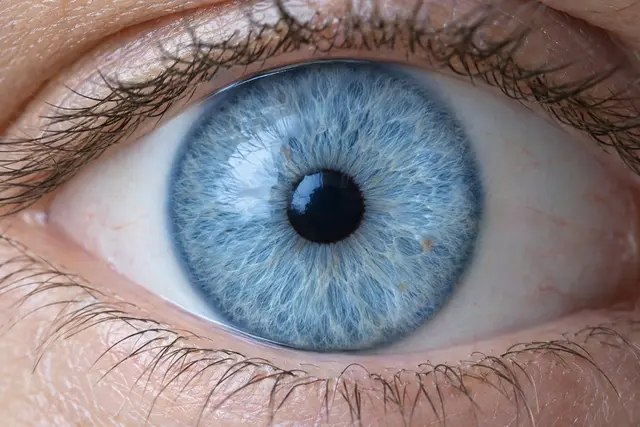
How rare are blue eyes?
Blue eyes appear in an estimated 8–10% of people worldwide, which makes blue the second most common eye color. That is about 1 person in 11. The figure comes from secondary summaries, not a global count.
In the United States the number is much higher. Blue is on 23.7% of the 235 million driver's licenses in a 2025 PLOS ONE study, and a 2014 Harris Poll found 27%. Both are close, which is unusual for eye color data.
Why do blue eyes look blue?
Blue eyes contain no blue pigment. According to the American Academy of Ophthalmology, people with blue eyes have no pigment in the front layer of the iris, called the stroma. Light entering that layer scatters, and more of the blue end of the spectrum reflects back out.
It is the same kind of effect that makes the sky look blue. The color is structural, so it depends on the light around it. That is why blue eyes can read pale in sunlight and deeper in shade.
Direct measurements of iris tissue back this up. Blue irises always had very low pigment content in that 1998 study.
Where did blue eyes come from?
Blue eyes trace to a single change near the OCA2 gene. A 2008 study led by Hans Eiberg at the University of Copenhagen looked at 155 blue-eyed Danes and a few blue-eyed people from Turkey and Jordan. They all shared the same stretch of DNA in the HERC2 gene, which sits next to OCA2.
The key variant, rs12913832, works like a dimmer. It lowers the activity of OCA2, and less OCA2 means less melanin in the iris. The shared pattern points to one founder, a common ancestor who carried the change.
When that person lived is less certain. Reports of the Copenhagen work put it at 6,000 to 10,000 years ago, and All About Vision cites about 14,000 years. Treat any exact date with caution.
This variant is not the whole story either. The largest study so far, covering almost 195,000 people, found 61 genomic regions tied to eye color. Common variants across them explain about 53% of the variation between people.
Where are blue eyes most common?
Blue peaks in northern Europe and falls off quickly to the south and east. These figures are from a 2019 literature review, as reproduced by Healthline. The review counted gray eyes as blue.
| Country | Blue eyes (gray included) |
|---|---|
| Iceland | 74.5% |
| Netherlands | 60.9% |
| Great Britain | 42.8% |
| Germany | 39.6% |
| France | 22% |
| Uzbekistan | 3.4% |
| Kazakhstan | 3.3% |
| Armenia | 3.1% |
You may see a claim that about 89% of people in Estonia and Finland have blue eyes. It is repeated widely, but we could not trace it to a study, so we leave it out of our figures.
Inside the United States, the license study found blue was the single most common color in three states: South Dakota (38%), Maine (37.7%) and Wyoming (35.6%). The authors note that those states have large white populations, at 88%, 96% and 94%. California had the lowest share at 15.3%, with Texas next at 16.2%. Our eye color by state table has the full list.
Are all babies born with blue eyes?
No. Only about 1 in 5 did in the one study that checked. In the Newborn Eye Screening Test study, 20.8% of 192 newborns had blue eyes and 63% had brown. Melanin often builds after birth, so some blue-eyed babies do end up with darker eyes.
Are blue eyes linked to health risks?
Lighter irises are linked to a higher risk of uveal melanoma, a rare eye cancer. A 2014 review reported that link, and it suggested that light irises and UV exposure together may add to the risk. The same review found no consistent link with macular degeneration.
These are population patterns, not predictions. Sunglasses with UV protection are sensible for anyone, whatever their eye color.
Blue eyes FAQs
What percentage of the world has blue eyes?
An estimated 8–10%, or about 1 person in 11. In the United States the figure is 24–27%.
Do all blue-eyed people share one ancestor?
A 2008 University of Copenhagen study suggests so. It found that blue-eyed people from Denmark, Turkey and Jordan shared the same HERC2 variant pattern, which points to a single founder mutation.
Will blue eyes disappear?
No. The variants behind blue eyes are recessive, so they can pass silently through brown-eyed carriers. Mixing populations can make blue eyes less concentrated in one place, but the variants stay in the gene pool.
Can blue eyes turn brown?
In babies, yes, since melanin often builds in the first years. In adults, a real color change is unusual. A sudden change or a change in one eye should be examined by an eye doctor.
Sources for this page
- Hashem, Menicacci & Granet: Iris color distribution in the United States of AmericaPLOS ONE (2025)
- Your Blue Eyes Aren't Really Blue (includes the 2014 Harris Poll results)American Academy of Ophthalmology
- What is the rarest eye color?All About Vision
- Eiberg et al.: Blue eye color in humans may be caused by a perfectly associated founder mutation in a regulatory element located within the HERC2 gene inhibiting OCA2 expressionHuman Genetics (2008)
- Simcoe et al.: Genome-wide association study in almost 195,000 individuals identifies 50 previously unidentified genetic loci for eye colorScience Advances (2021)
- Prota et al.: Characterization of melanins in human irides and cultured uveal melanocytes from eyes of different colorsExperimental Eye Research (1998)
- Katsara & Nothnagel: True colors, a literature review on the spatial distribution of eye and hair pigmentationForensic Science International: Genetics (2019)
- Eye Color Percentages (reproduces the Katsara country table)Healthline
- Ludwig et al.: What colour are newborns' eyes? Prevalence of iris colour in the Newborn Eye Screening Test studyActa Ophthalmologica (2016)
- Sun, Lin & Pan: Iris color and associated pathological ocular complications, a review of epidemiologic studiesInternational Journal of Ophthalmology (2014)
Estimate ranges are our own synthesis of these sources. Read how we calculate them.