Amber eyes
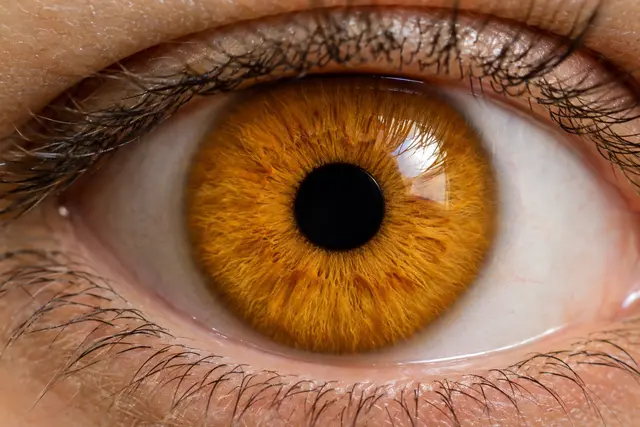
Solid golden-copper irises. Rare, though nobody has measured how rare.
By the Eye Color Rarity Editorial Team · Sources checked November 2026
How rare are amber eyes?
Amber eyes are rare, but nobody has measured how rare. Our estimate is about 3% of people worldwide, with a range of 1–5% and a low confidence label. It is the weakest number on this site, and we would rather say so than give you false precision.
You will often see 5% quoted. WorldAtlas gives that figure, and Vision Center repeats it, but we could not find a study behind it. All About Vision gives no percentage for amber at all.
Why is amber so hard to count?
Almost no dataset has an amber category. The 2014 Harris Poll reported brown, blue, hazel, green and "other". The 2019 review of European data sorted eyes into brown, intermediate and blue.
The 2025 license study is the most useful clue. Some states do record amber, and the researchers grouped it into "other" along with pink, ruby, maroon, dichromatic and unknown. That whole group came to 3.3% of 235 million licenses.
The state table tells us more. Arizona (29.5%) and California (8.6%) account for 98.6% of that group, which looks like missing data, not amber eyes. In the other 29 states, "other" adds up to well under 0.1% of licenses. So amber is almost never written down, whatever the true number is.
This puts a ceiling on the recorded figure, not on the real one. It is still the reason we set our global estimate below the popular 5%: if amber were that common, we would expect far more of it to appear on forms that allow it.
We can't push the figure much lower with confidence. People with golden eyes may tick brown or hazel on a form, and light-brown eyes in Asia and Latin America are rarely classified at all.
What causes amber eyes?
Amber most likely comes from a warm pigment spread evenly across the iris. Popular guides credit a yellow pigment called lipochrome. Researchers usually discuss pheomelanin, the red-yellow form of melanin that also colors red hair.
We found no study that measured pigment in amber irises specifically. The closest evidence is work on green irises, which found a pheomelanin-type pigment there. Treat the amber explanation as a reasonable inference, not a settled fact.
What sets amber apart visually is evenness. There is no ring of a second color, so the whole iris reads as one golden tone, and it can look almost metallic in strong light.
How can you tell if your eyes are amber?
Check whether the color stays the same from the pupil to the outer edge. Stand near a window in daylight, out of direct sun, and look closely in a mirror.
- If the whole iris is one golden, honey or copper tone, the eye is amber.
- If you see a ring of brown or gold that turns green toward the edge, it is hazel.
- If the tone is a warm brown rather than gold, and it stays brown in daylight, it is light brown.
Light brown is the usual mix-up. Many eyes look golden in direct sun and brown everywhere else, and those are brown. Amber stays golden indoors. For more detail, see hazel vs. amber eyes.
Are amber eyes rarer than green?
We don't know, and we don't think anyone does. Our amber range of 1–5% overlaps our green range of 1–4%. Green has a far better evidence base, with both big U.S. datasets at 9%, and amber has no direct count.
Our point estimates place amber slightly above green, but that order isn't reliable. See what the rarest eye color really is for how we handle this.
Amber eyes FAQs
What percentage of people have amber eyes?
No study has measured it. Our estimate is about 3% worldwide, in a range of 1–5%, with low confidence. The popular 5% figure has no primary source we could find.
Are amber eyes the same as hazel eyes?
No. Amber is one even golden tone across the iris. Hazel mixes two or more colors, usually with a brown or gold ring near the pupil.
Are amber eyes just light brown?
They can be hard to separate. Amber stays golden in ordinary light, while light brown eyes look golden only in direct sun and brown the rest of the time.
Do U.S. driver's licenses list amber eyes?
Some states do, but it barely shows up. In the 2025 PLOS ONE study, amber was grouped into 'other', and outside Arizona and California that whole group was well under 0.1% of licenses.
Sources for this page
- Hashem, Menicacci & Granet: Iris color distribution in the United States of AmericaPLOS ONE (2025)
- Your Blue Eyes Aren't Really Blue (includes the 2014 Harris Poll results)American Academy of Ophthalmology
- The World's Population By Eye ColorWorldAtlas
- The Rarest Eye Colors, Ranked by PercentageVision Center
- What is the rarest eye color?All About Vision
- Katsara & Nothnagel: True colors, a literature review on the spatial distribution of eye and hair pigmentationForensic Science International: Genetics (2019)
- Prota et al.: Characterization of melanins in human irides and cultured uveal melanocytes from eyes of different colorsExperimental Eye Research (1998)
Estimate ranges are our own synthesis of these sources. Read how we calculate them.