What Is the Rarest Eye Color in the World?
Green is the usual answer at about 2%, but gray is probably rarer. We compare the ranking against 235 million U.S. license records to find out what holds up.
Eye Color Rarity Editorial Team
Research & Data
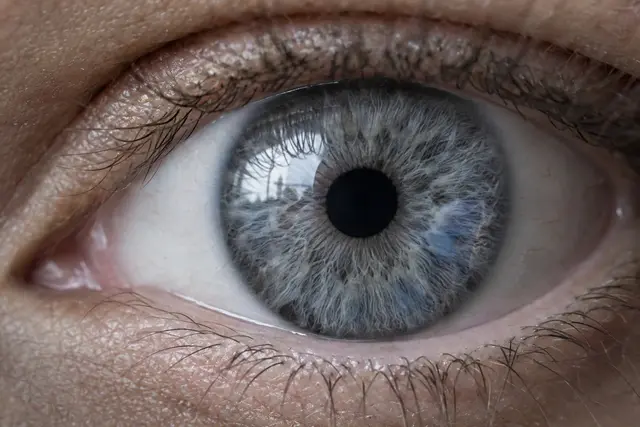
The usual answer is green, at about 2% of the world. The better answer is that gray is probably rarer, at around 1% or less. Green holds the title because it is the rarest color most surveys bother to count. When a dataset does count gray separately, gray comes in about 13 times below green.
If you count conditions as well as colors, heterochromia and the red or violet look linked to albinism are rarer than both. Each of these answers is right for a slightly different question, so we will go through them in order.
Eye colors ranked from rarest to most common
This is our ranking, with the direct U.S. counts next to the estimates. The worldwide column is our estimate, explained in the methodology. The U.S. columns are real data from the 2025 license study and the 2014 Harris Poll.
| Eye color | Worldwide (estimate) | U.S. licenses | U.S. poll |
|---|---|---|---|
| Gray | ~1% (0.5–3%) | 0.7% | Not listed |
| Green | ~2% (1–4%) | 9% | 9% |
| Amber | ~3% (1–5%) | Not counted | Not listed |
| Hazel | ~5% (4–8%) | 10.3% | 18% |
| Blue | ~9% (8–10%) | 23.7% | 27% |
| Brown | ~75% (70–80%) | 53% | 45% |
The bottom three ranges overlap, so the order among gray, green and amber is not settled. Blue and brown are not in doubt. You can compare any two colors in our rarity tool, and if you aren't sure of your own color, try the eye color test.
Why does everyone say green?
Green is the rarest color that gets measured. The 2014 Harris Poll asked more than 2,000 Americans about their eyes and reported brown, blue, hazel, green and a 1% "other". Green came last among the named colors. Writers repeated the result, and over time "the rarest color in the poll" became "the rarest color".
Worldwide lists have a similar history. WorldAtlas gives 70–80% for brown, 8–10% for blue, 5% each for hazel and amber, 3% for gray and 2% for green. Those figures are copied widely, but the page offers little sourcing for them. We could not find a global study behind them, and nobody has run one.
Why gray is probably rarer than green
The biggest dataset available puts gray far below green. Researchers collected eye color records from 235,423,085 driver's licenses in 31 states. Green appeared on 21,258,873 of them. Gray appeared on 1,597,675. That is 9% against 0.7%.
The gap holds up state by state. Gray is below green in all 31, and in most states it is more than ten times smaller. The closest is West Virginia, where gray reaches 2.2% and green is 12.9%. Our eye color by state table has every state.
Could U.S. data mislead us about the world? Partly. Gray is often linked with northern and eastern Europe, and those groups are not represented equally in America. But Americans report light eyes far more often than the world does, so a color that is under 1% there would have to be concentrated strongly somewhere else to reach the 3% that WorldAtlas lists.
There is one more reason for caution. Gray is easy to mistake for blue, and people may tick "blue" on a form when no one is checking. That would make gray look rarer than it is. Even if half of all gray-eyed drivers chose blue, gray would still be far behind green.
Green is the rarest color that surveys count. Gray is the rarest color they usually don't.
Where does amber fit?
Amber might be rarer than green or more common. No one has measured it. The popular figure of 5% has no study behind it that we could find. Polls leave amber out, and the European review we rely on has no amber group.
License data offers one hint. Amber was grouped into "other" with labels like unknown and dichromatic, and outside Arizona and California that whole group was well under 0.1% of licenses. That doesn't prove amber is that rare, because most forms don't offer it. It does show how little of it gets recorded. Our amber eyes profile goes through the reasoning.
Rarer than any color: heterochromia and albinism
If conditions count, heterochromia and red or violet eyes rank below every standard color. Heterochromia is not a color but a difference in color between or within the eyes.
Complete heterochromia has two direct counts, which is more than most colors can claim. A Vienna study from the 1960s and a 2022 West Point study of 11,111 cadet portraits both landed on 0.063%, or about 1 person in 1,600. Counting patches and rings as well, Vienna found 0.256%, about 1 in 400. See our heterochromia guide.
Red and violet are rarer again, though they are not true iris colors. The National Organization for Albinism and Hypopigmentation calls red eyes a myth: in some lighting, blood vessels at the back of the eye show through an iris with little pigment. Albinism affects about 1 in 18,000 to 20,000 people in the U.S., most of them have blue eyes, and only some will ever show that effect.
Why is green rare at all?
Green needs low melanin and a small amount of warm pigment at the same time. There is no green pigment in the eye. Light scattered in the iris supplies the blue, and a pheomelanin-type pigment supplies the yellow. Too much melanin and the eye turns hazel or brown. Too little warm pigment and it stays blue.
Geography matters as well. The variants behind light eyes are concentrated in people of European ancestry, so green is uncommon on a world scale. That is why 9% of American license holders report it and only about 2% of the world does.
What about "rarest" colors you see online?
A few popular claims don't hold up. True black eyes don't exist, since they are very dark brown. We found no documented natural violet iris outside the lighting effect above. And a list that gives a color to one decimal place worldwide is claiming precision that no dataset can support.
The short answer
If someone asks at a party, say green, about 2% of the world. If they want the accurate version, say gray is probably rarer, it just rarely gets counted.
Sources
- Iris color distribution in the United States of AmericaHashem, Menicacci & Granet, PLOS ONE (2025)
- Your Blue Eyes Aren't Really Blue (includes the 2014 Harris Poll results)American Academy of Ophthalmology
- The World's Population By Eye ColorWorldAtlas
- What is the rarest eye color?All About Vision
- True colors: a literature review on the spatial distribution of eye and hair pigmentationKatsara & Nothnagel, Forensic Science International: Genetics (2019)
- Estimating the prevalence of heterochromia iridum from high-resolution digital yearbook portraitsDabkowski et al., Journal of Optometry (2022)
- What is Albinism?National Organization for Albinism and Hypopigmentation
- Characterization of melanins in human irides and cultured uveal melanocytes from eyes of different colorsProta et al., Experimental Eye Research (1998)