Heterochromia
Two colors in the eyes, in about 1 in 400 people. Two fully different eyes are rarer still.
By the Eye Color Rarity Editorial Team · Sources checked November 2026
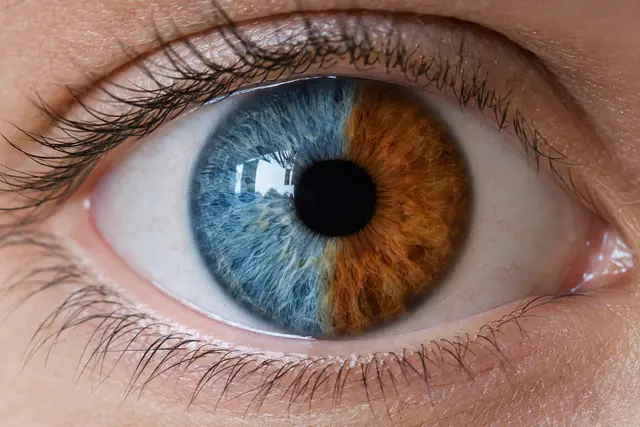
How rare is heterochromia?
Complete heterochromia, where the two eyes are different colors, affects about 1 person in 1,600. All forms together, including patches and rings, come to about 1 in 400. Those numbers rest on two direct counts, made about 50 years apart, which is more than we can say for most eye color statistics.
| Study | Who was examined | Result |
|---|---|---|
| Stelzer, Vienna, 1979 | 25,346 people, examined in person | 65 cases of all types: 0.256% |
| Stelzer, as reported in the study below | Same sample, complete and non-pathological cases only | 0.063% |
| West Point, 2022 | 11,111 cadet portraits, confirmed by an optometrist | 7 complete cases: 0.063% |
| NEST newborn study, 2016 | 192 newborns in one hospital | 0.5% partial heterochromia |
The match between Vienna and West Point is striking. The West Point authors gave a 95% confidence interval of 0.028% to 0.133%, and they note that they may have missed subtle cases, so their number could be low.
The newborn figure should be read with care. Half a percent of 192 babies is a single child.
You will also see claims of about 6 in 1,000 people online, and "under 1%" in many guides. "Under 1%" is true but vague. We could not trace the 6 in 1,000 figure to a study, and it is about ten times higher than both direct counts of complete heterochromia.
What are the types of heterochromia?
There are three main types, based on where the color difference sits.
| Type | What it looks like |
|---|---|
| Complete | Each eye is a different color, such as one blue and one brown |
| Sectoral (partial) | A wedge or patch of a second color in one iris |
| Central | A ring of a different color around the pupil, shading to another color at the edge |
Central heterochromia overlaps with hazel, since both have an inner ring. The difference is mainly how sharp the edge looks, and there is no agreed boundary.
Stelzer's Vienna study noted that partial patches usually sat in the lower half of the iris. It also found heterochromia more often in women, at 0.37% against 0.157% in men. Five out of six cases were people aged 2 to 19.
What causes heterochromia?
Most lifelong heterochromia is harmless, and it comes from melanin being spread unevenly during development. The West Point authors describe it as generally harmless and easy to diagnose. They also point out that some cases are linked to underlying conditions that warrant investigation.
Present from birth or early childhood
Many cases have no linked condition at all. Others are part of a syndrome. Waardenburg syndrome, at about 1 in 40,000 people, can cause heterochromia along with hearing loss. Congenital Horner syndrome can leave one iris lighter, because the nerve supply that drives pigment is missing.
Appearing later in life
This is the kind that matters medically. Vision Center lists injury, inflammation, tumors and certain eye drops among the causes of acquired heterochromia, along with Horner syndrome.
When to see an eye doctor
A new difference in color between your eyes should be examined promptly, especially with pain, redness, blurred vision, or a drooping eyelid. A child with new heterochromia should be seen too. Heterochromia you have had since childhood and that has already been checked is usually no cause for concern.
What about red or violet eyes?
Red and violet are visual effects, not iris colors, and they are mostly linked to albinism. The National Organization for Albinism and Hypopigmentation calls red eyes a myth. In some lighting, blood vessels at the back of the eye can be seen through an iris with little pigment, which gives a reddish or violet look.
Most people with albinism have blue eyes, and some have hazel or brown. Albinism itself affects about 1 in 18,000 to 20,000 people in the U.S., and as many as 1 in 3,000 in some other regions, so a red or violet appearance is rarer than any color on this site. Albinism also comes with vision problems that glasses can't fully correct.
Heterochromia FAQs
How rare is heterochromia?
Complete heterochromia affects about 1 person in 1,600, based on two direct counts that both found about 0.063%. All forms together were about 0.26%, or 1 in 400, in a Vienna sample of 25,346 people.
Is heterochromia dangerous?
Usually not, if you have had it since childhood. It can be linked to syndromes, and a new color difference can signal injury, inflammation or other conditions, so it should be checked by an eye doctor.
Can heterochromia appear later in life?
Yes. Causes of acquired heterochromia include injury, inflammation, tumors, certain eye drops and Horner syndrome. Any new difference between your eyes needs an exam.
Is heterochromia inherited?
Sometimes. It can run in families and can be part of inherited conditions such as Waardenburg syndrome, but many people with it have no family history.
Are red or violet eyes real?
Not as iris colors. In people with very little iris pigment, certain lighting can reveal blood vessels at the back of the eye, which gives a reddish or violet look. Most people with albinism have blue eyes.
Sources for this page
- Dabkowski et al.: Estimating the prevalence of heterochromia iridum from high-resolution digital yearbook portraitsJournal of Optometry (2022)
- Stelzer: Iris heterochromia, variations in form, age changes, sex dimorphismAnthropologischer Anzeiger (1979)
- Ludwig et al.: What colour are newborns' eyes? Prevalence of iris colour in the Newborn Eye Screening Test studyActa Ophthalmologica (2016)
- The Rarest Eye Colors, Ranked by PercentageVision Center
- What is Albinism?National Organization for Albinism and Hypopigmentation
- The World's Population By Eye ColorWorldAtlas
Estimate ranges are our own synthesis of these sources. Read how we calculate them.