Green eyes
The rarest of the four colors most surveys track, at around 1 in 50 people worldwide.
By the Eye Color Rarity Editorial Team · Sources checked November 2026
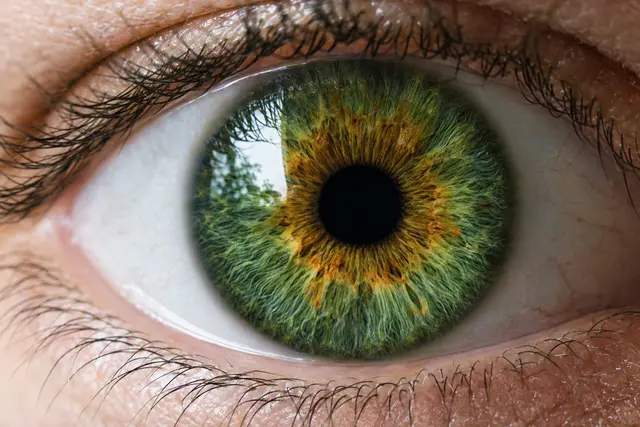
How rare are green eyes?
Green eyes appear in about 2% of people worldwide, or roughly 1 person in 50. It is the rarest of the four colors that most surveys track, which are brown, blue, hazel and green. That 2% is repeated by WorldAtlas, All About Vision and others, though none of them shows a global count behind it.
The U.S. figure is on firmer ground. The 2025 license study found green on 9% of 235 million licenses, and the 2014 Harris Poll also found 9%. Two very different methods gave the same number, and that happened for no other color.
So about 1 American in 11 reports green eyes, against 1 person in 50 worldwide. The gap makes sense, because green is concentrated in people with European ancestry and the U.S. has far more of them than the world does.
Is green the rarest eye color?
Green is the usual answer, but gray is probably rarer. Gray was on just 0.7% of U.S. licenses, about 13 times fewer than green. Gray simply gets left out of most surveys, which is how green earned the title. Our article on the rarest eye color goes through the whole ranking.
What makes eyes green?
Green comes from a small amount of warm pigment combined with scattered light. There is no green pigment in the eye. The stroma scatters light toward blue, as it does in blue eyes, and a thin layer of yellowish pigment shifts what you see to green.
A 1998 study of iris tissue measured this directly. It linked green irises to a pheomelanin-type pigment, the red-yellow form of melanin. Green-blue mixed irises were mostly eumelanin, the brown-black form, which shows how small a change can move an eye from one label to another.
Popular guides often call the yellow pigment lipochrome. It is an older term, and you will see both.
What genes cause green eyes?
No single gene does. According to MedlinePlus Genetics, OCA2 and HERC2 play a major role, and other genes including ASIP, IRF4 and TYR add to it. Green sits on a spectrum between blue and hazel, so the same variants can land in different places depending on what else a person inherits.
This is why two green-eyed parents can have children with blue, green or hazel eyes. Our genetics guide explains how that works.
Where are green eyes most common?
We can only answer this roughly, because green is rarely counted alone. The 2019 review of European data merged green and yellow into an "intermediate" group, as reproduced by Healthline.
| Country | Intermediate eyes (green and yellow) |
|---|---|
| France | 44% |
| Germany | 33.2% |
| Great Britain | 25.5% |
| Armenia | 16.8% |
| Iceland | 14.2% |
| Kazakhstan | 11.7% |
| Netherlands | 11.4% |
| Uzbekistan | 6% |
These numbers show the shape of the pattern, not a green count, and studies drew the line differently. Many websites name Ireland and Scotland as the world capitals of green eyes. We could not find a primary dataset for that, so we don't repeat it as fact.
In the U.S. license data, green peaks in Nebraska (14%) and Kentucky (13.4%), and is lowest in New York (6.9%). It passed hazel in seven states: Missouri, Texas, West Virginia, Wisconsin, Georgia, Kentucky and Nebraska. The authors suggest that may partly reflect people choosing "green" over "hazel" on the form. All 31 states are in our eye color by state table.
Why do green eyes seem to change color?
Scattered light depends on the light around it. The pigment stays put, but the blue part of the mix changes with brightness and surroundings. Green eyes can look bluer outdoors and more golden under warm bulbs, and clothing color has a small effect too.
Green eyes FAQs
What percentage of people have green eyes?
About 2% worldwide, in a range of 1–4%. In the United States, 9% of license records list green, and a 2014 Harris Poll also found 9%.
Is green the rarest eye color?
It is the rarest of the four colors most surveys track. Gray is probably rarer, at 0.7% of U.S. license records against 9% for green, but gray is left out of most surveys.
Can two brown-eyed parents have a green-eyed child?
Yes. Both parents can carry variants that lower melanin, and a child can inherit a combination that gives green eyes.
Are green eyes and hazel eyes the same?
No, though they can be hard to separate. Green eyes look mostly green across the iris. Hazel eyes shift from a brown or gold ring near the pupil to green or lighter tones at the edge.
Sources for this page
- Hashem, Menicacci & Granet: Iris color distribution in the United States of AmericaPLOS ONE (2025)
- Your Blue Eyes Aren't Really Blue (includes the 2014 Harris Poll results)American Academy of Ophthalmology
- The World's Population By Eye ColorWorldAtlas
- What is the rarest eye color?All About Vision
- Prota et al.: Characterization of melanins in human irides and cultured uveal melanocytes from eyes of different colorsExperimental Eye Research (1998)
- Is eye color determined by genetics?MedlinePlus Genetics, U.S. National Library of Medicine
- Katsara & Nothnagel: True colors, a literature review on the spatial distribution of eye and hair pigmentationForensic Science International: Genetics (2019)
- Eye Color Percentages (reproduces the Katsara country table)Healthline
Estimate ranges are our own synthesis of these sources. Read how we calculate them.