Gray eyes
Probably the rarest standard eye color, at about 1 in 100 people or fewer.
By the Eye Color Rarity Editorial Team · Sources checked November 2026
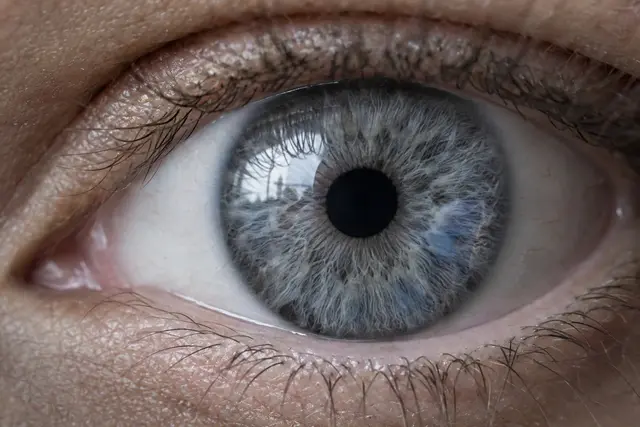
How rare are gray eyes?
Gray is probably the rarest of the standard eye colors, at around 1% of people or fewer. The one direct count is American. In a 2025 PLOS ONE study, gray was on 1,597,675 of 235,423,085 driver's licenses. That is 0.7%, the smallest named color in the data.
You will also see gray listed at 3% of the world. That figure comes from WorldAtlas, which doesn't cite a study for it. It is hard to square with the license data, since the United States has far more light-eyed people than the world as a whole.
We estimate about 1% worldwide, in a range of 0.5–3%. We keep the top of the range high and the confidence label low, for two reasons. People with gray eyes may tick "blue" on a form, and gray may be more common in parts of northern and eastern Europe that are not reflected in U.S. records.
Why do most rankings miss gray?
Most surveys never give gray its own box. The 2014 Harris Poll reported brown, blue, hazel, green and a 1% "other". The 2019 review of European data counted gray as blue.
That is how green became the standard answer to "what is the rarest eye color". Green is the rarest color that gets measured. Once a dataset does separate gray, it comes in about 13 times below green.
| Color | U.S. license records | Share |
|---|---|---|
| Green | 21,258,873 | 9% |
| Gray | 1,597,675 | 0.7% |
What makes eyes gray?
Nobody knows for sure. This surprises people, because many websites state a confident answer. A geneticist writing for The Tech Interactive and Stanford put it plainly: "we do not know the exact genes that cause gray vs. blue eyes."
That same answer lays out the leading ideas. Dark gray eyes may have a thin layer of melanin on the front of the iris that clouds the blue reflection. Light gray eyes may have even less melanin than blue eyes. Gray may also depend on the amount or size of proteins in the stroma, in the way that water droplets turn a sky from blue to gray.
You will read in many places that gray eyes have "denser collagen" than blue eyes. It is a plausible idea, but we could not find a primary study that measured it, so we don't present it as established.
Gray and blue are probably close genetically. OCA2 may be involved, but that hasn't been tested directly.
How do you tell gray eyes from blue?
Gray looks muted and silvery, with little blue in it, even in good light. Compare your eye against something plainly blue, such as a clear sky or a blue shirt. A blue eye will match the hue, only paler. A gray eye will look colorless beside it.
Gray eyes also tend to shift with their surroundings. Because so little pigment is involved, they can pick up a blue or green cast from clothing and light. If yours lean blue most of the time, you can fairly call them blue-gray. No official boundary exists.
Where are gray eyes most common?
They are generally linked to northern and eastern Europe, but we have no measured figures for that. The European review merged gray into blue, so it can't help. If you know of a dataset that counts gray separately, please send it to us.
The U.S. license data does break gray down by state. West Virginia stands out at 2.2%, about three times the national rate. Wisconsin (1.2%) and Washington (1.1%) come next, and every other state is under 1%. Our eye color by state table has all 31.
Gray eyes FAQs
What percentage of people have gray eyes?
In the one direct count, 0.7% of U.S. driver's licenses. We estimate about 1% worldwide, in a range of 0.5–3%, with low confidence.
Are gray eyes rarer than green eyes?
Probably. On U.S. license records gray is about 13 times less common than green. Most surveys do not count gray at all, which is why green is usually called the rarest.
Are gray eyes just pale blue eyes?
They may be closely related, but the cause is still unknown. Geneticists say the exact genes separating gray from blue have not been identified.
Do gray eyes change color?
They can seem to. Gray eyes hold little pigment, so lighting and nearby colors can give them a blue or green cast. A sudden real change in iris color should be checked by an eye doctor.
Sources for this page
- Hashem, Menicacci & Granet: Iris color distribution in the United States of AmericaPLOS ONE (2025)
- Your Blue Eyes Aren't Really Blue (includes the 2014 Harris Poll results)American Academy of Ophthalmology
- The World's Population By Eye ColorWorldAtlas
- Katsara & Nothnagel: True colors, a literature review on the spatial distribution of eye and hair pigmentationForensic Science International: Genetics (2019)
- Ask a Geneticist: gray eyes versus blue eyesThe Tech Interactive and Stanford University
Estimate ranges are our own synthesis of these sources. Read how we calculate them.