Hazel vs. Amber Eyes: How to Tell the Difference
Hazel blends brown, gold and green. Amber is one solid golden tone. A simple test for telling them apart, how each looks in photos, and how rare each one is.
Eye Color Rarity Editorial Team
Research & Data
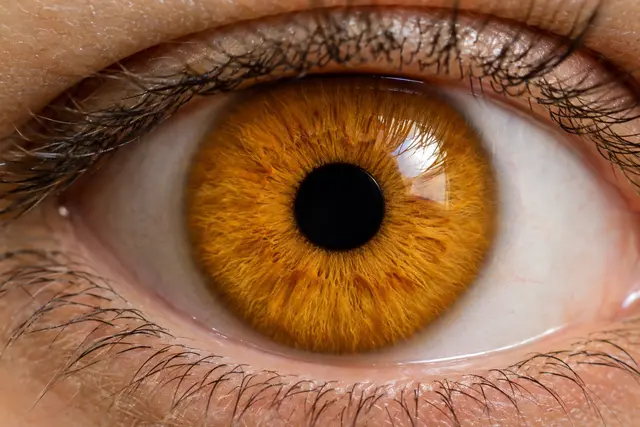
The difference is in the pattern: hazel eyes have two or more colors, and amber eyes have one. A hazel iris usually shows a brown or gold ring near the pupil that shifts to green toward the edge. An amber iris is the same golden or coppery tone all the way across.
That sounds simple until you try it on your own eyes in a bathroom mirror. So here is a proper test, along with what the data says about each color.
Hazel and amber side by side
| Hazel | Amber | |
|---|---|---|
| Pattern | Two or more colors, shifting outward | One even tone |
| Usual colors | Brown or gold center, green edge | Gold, honey or copper |
| Green present? | Yes, usually | No |
| In changing light | Shifts between greener and browner | Stays golden, gets brighter or darker |
| Worldwide estimate | ~5% (4–8%) | ~3% (1–5%), low confidence |
| U.S. data | 10.3% to 18% | Not counted |
The one-minute mirror test
You need a mirror, a window, and daylight that isn't falling directly on your face. Warm bulbs make eyes look more golden, and direct sun can make brown eyes look amber.
- Stand facing a window on a bright day, a step or two back from the glass.
- Look at the area right next to your pupil and note the color.
- Look at the outer edge of your iris and note that color.
- If the two match and the tone is golden, your eyes are amber.
- If the two differ, especially if you see green at the edge, your eyes are hazel.
- If the two match and the tone is brown, your eyes are light brown.
Repeat it on a second day if you are not sure. The color you see most often in plain daylight is the one to go with.
Can a photo tell you?
A photo can help, but only if you are careful. Phones adjust color automatically, and filters shift it further. Take a close-up in daylight with the flash off, then compare it with something of a known color, such as a white sheet of paper in the same shot.
If the white looks warm in the picture, your eye color will look too golden as well.
What makes hazel and amber different?
The main difference is how evenly the pigment is spread. In hazel eyes, melanin is denser around the pupil and thinner at the edge, where scattered light adds green. Iris tissue research found a eumelanin to pheomelanin ratio of about 1.3 to 1 in hazel and blue-green irises, so warm pigment makes up a large share.
Amber is thought to come from warm pigment spread evenly, with no ring and no green. We found no study that measured amber irises on their own, so that explanation is an inference from research on other light eyes.
Which one is rarer?
Amber is probably rarer than hazel, but the numbers for both are weak. Hazel has at least been counted. In the U.S. it is 10.3% of license records and 18% in a 2014 poll, which is the biggest gap for any color.
Amber has no direct count anywhere. The 5% figure seen online has no study we could find behind it. Our amber profile explains why we put it at about 3%, with low confidence.
Why this confusion matters for the statistics
Every statistic on eye color depends on someone making this exact judgment. When a person with golden eyes picks "hazel" on a form, hazel goes up and amber disappears. When a person with hazel-green eyes picks "green", the green figure goes up instead.
Researchers run into this too. A 2019 review of European eye color data folded hazel into brown so that it could compare older studies. That is why we show ranges and confidence labels, and why our methodology treats classification as a main limitation.
Still not sure? Try our free eye color test with a daylight photo, or read the hazel and amber profiles.
Sources
- Iris color distribution in the United States of AmericaHashem, Menicacci & Granet, PLOS ONE (2025)
- Your Blue Eyes Aren't Really Blue (includes the 2014 Harris Poll results)American Academy of Ophthalmology
- True colors: a literature review on the spatial distribution of eye and hair pigmentationKatsara & Nothnagel, Forensic Science International: Genetics (2019)
- The World's Population By Eye ColorWorldAtlas
- Characterization of melanins in human irides and cultured uveal melanocytes from eyes of different colorsProta et al., Experimental Eye Research (1998)